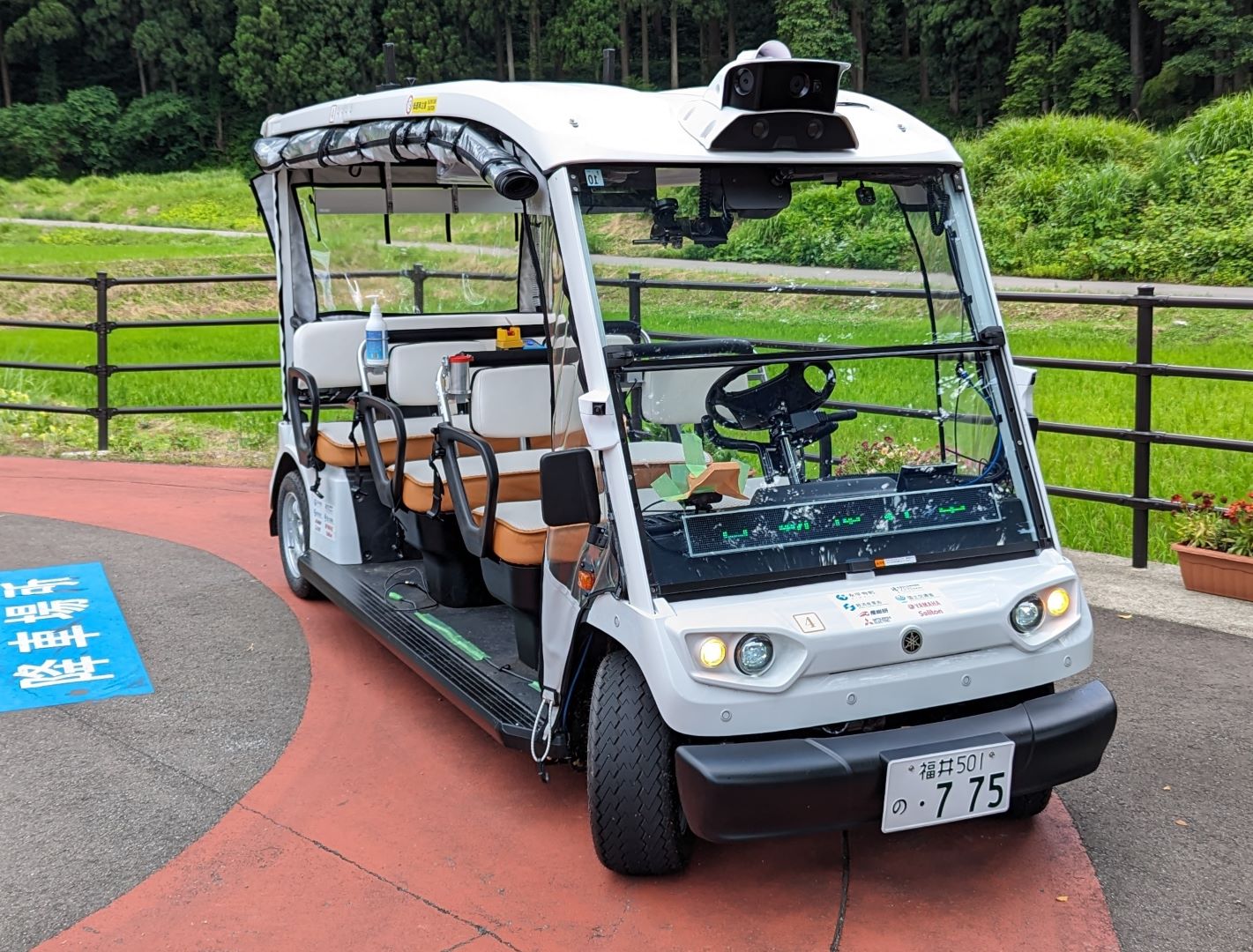
I Wanted to Learn About Advanced MaaS with Level 4 Autonomous Driving
Eiheiji Town in Fukui Prefecture is home to Eiheiji Temple, the head temple of the Soto Zen school. While I haven’t heard the specific triggers, I imagine this initiative, supported by METI (Ministry of Economy, Trade and Industry) and MLIT (Ministry of Land, Infrastructure, Transport and Tourism), aims to solve the pressing issue of transportation for both local residents and tourists in areas where such projects are implemented, by adopting advanced approaches. Among these, ZEN Connect has achieved Level 4 autonomous driving – full automation under specific conditions – since May 2023, making it the first in Japan. I wanted to experience this initiative firsthand and learn more about it.
It’s Not Always Available to Ride
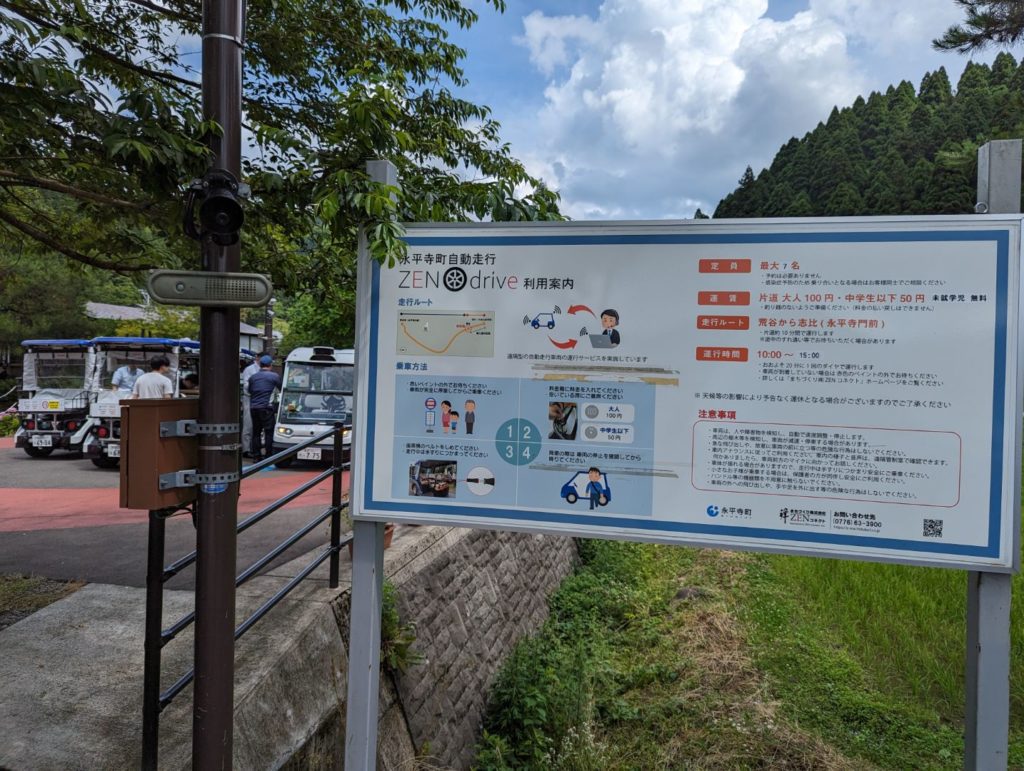
ZEN drive primarily operates on weekends and national holidays. Currently, it covers approximately a 2-kilometer stretch from Araya to Shihi (in front of Eiheiji Temple), taking about 10 minutes. The fare is 100 yen for adults and 50 yen for junior high school students and younger. It runs every 20 minutes (except during the 12 o’clock hour) from 10:00 to 15:00 for both directions, with a capacity of 7 passengers.
One would hope this would be quite convenient, but Araya is quite a distance from Eiheiji-guchi Station (a Fukui Railway station). You have to take a bus to get there, and since that same bus sometimes goes all the way to Eiheiji Temple, it feels like only people who specifically want to try this service would intentionally get off the bus here, or perhaps only Araya residents use it. Apparently, there used to be a Level 2 autonomous vehicle service from Eiheiji-guchi to Araya, but it’s no longer operating. The reason for this broken connection at Araya is that it crosses a road with a fair amount of traffic. It seems there are indeed some difficult hurdles in this area.
Green Slow Mobility
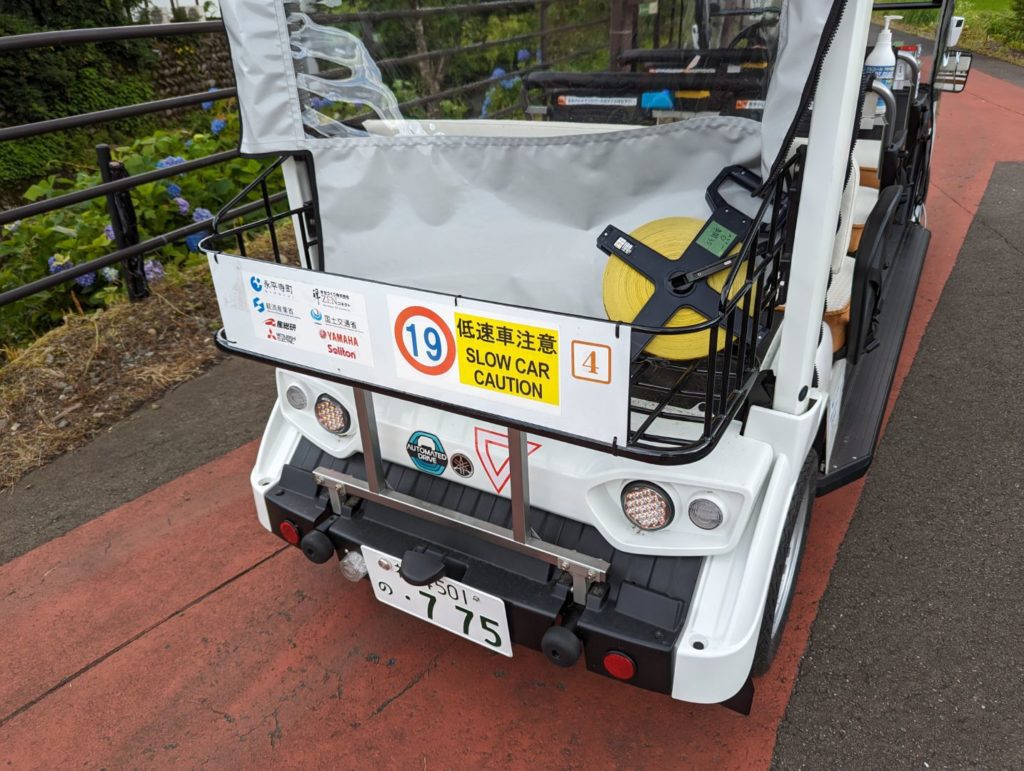
At work, I often shorten it to “GuriSlo.” Green Slow Mobility is a small-scale transportation service utilizing electric vehicles that can travel on public roads at speeds under 20 km/h, and it’s an umbrella term that includes the vehicles themselves. I believe it can contribute to solving various transportation challenges faced by communities and establishing low-carbon transportation, and I personally hope to contribute to its widespread adoption through my work.

Autonomous Driving Using Electromagnetic Guide Wires and RFID
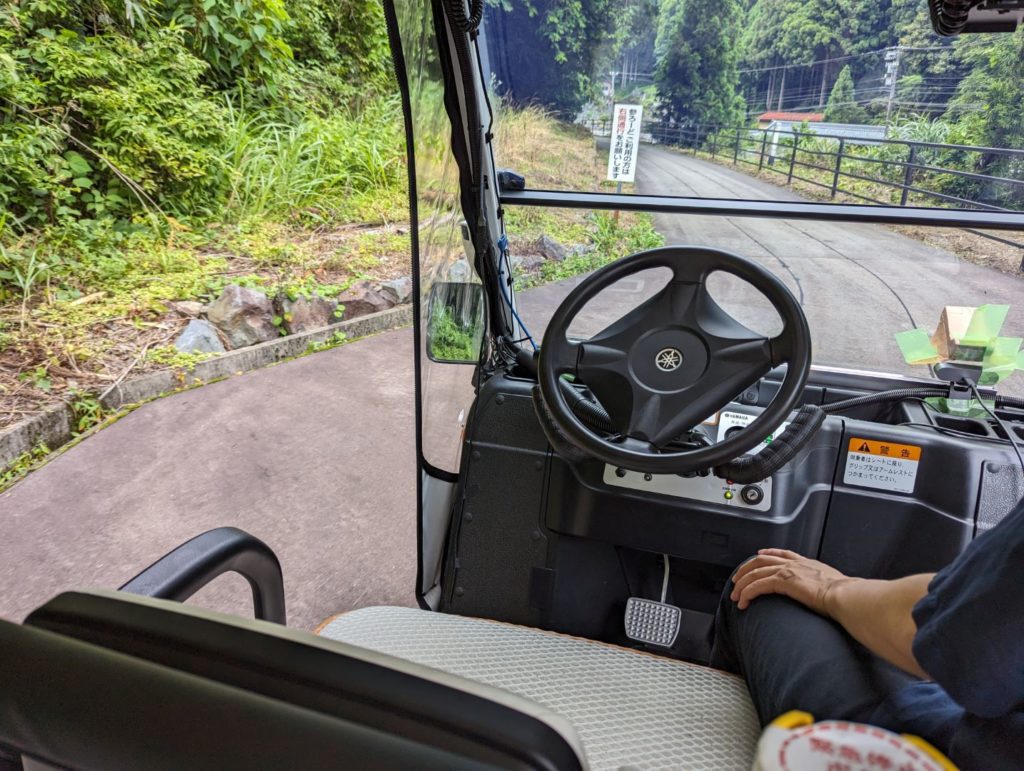
When you hear “autonomous driving,” you might imagine it making full use of various sensing technologies like HD maps, LiDAR, and cameras. However, the core of autonomous driving here lies in automatic steering using electromagnetic guide wires and speed control, including stopping, via RFID. The use of older, yet highly reliable technologies stems from a balance between environmental dependencies—like GPS not working in forests or cameras being unreliable in snow—and business feasibility, including cost and operational aspects. Speaking of which, I recall studying satellites in college and being surprised by the adoption of incredibly old, well-proven technologies. It truly reaffirmed to me how important this kind of sensibility is.
Regardless of the underlying tech, it was truly astonishing to see the vehicle smoothly start off in intense heat, steer itself, and automatically accelerate and decelerate. On this particular day, there were no bicycles or pedestrians on the road, so I couldn’t observe how it would behave in such situations, but I felt completely safe and at ease during the ride. Of course, I’ve had frequent experience with car autonomous driving, so I might have a sense of trust in such technology; for first-timers, it might be quite thrilling, I imagine.
Open and Refreshing
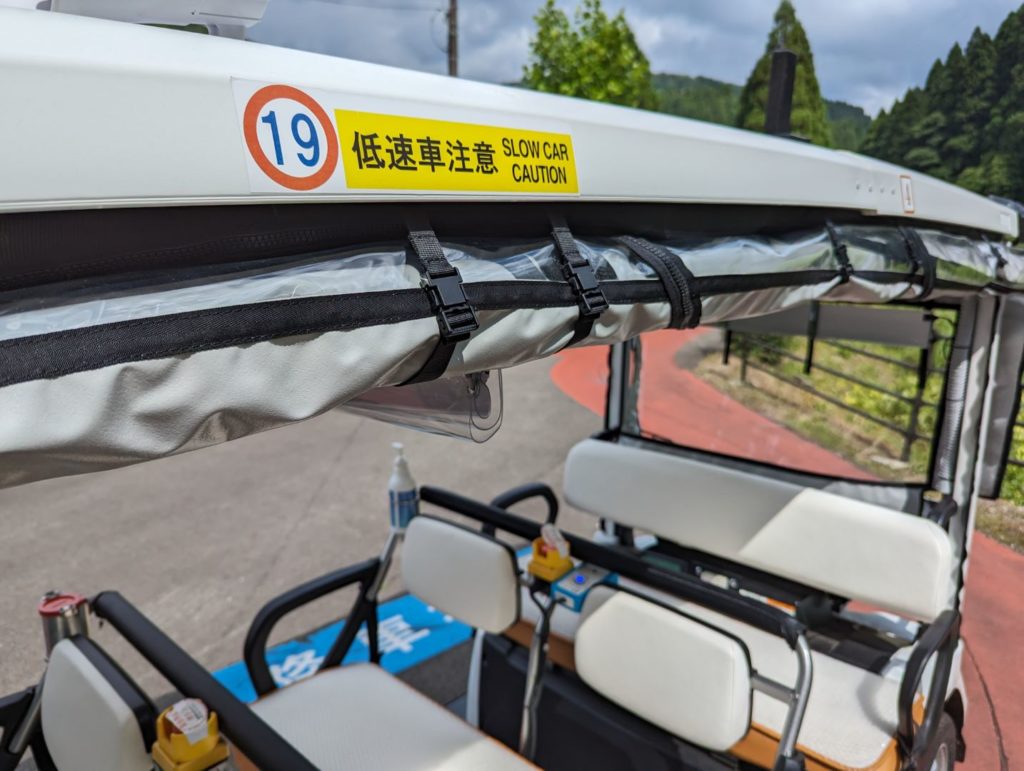
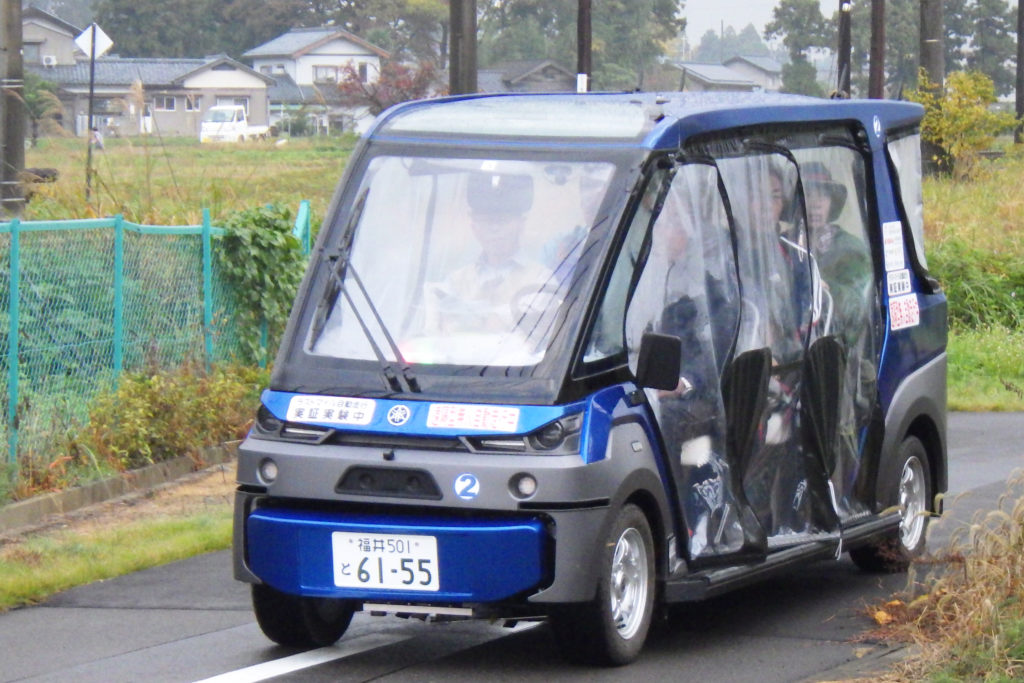
GuriSlo vehicles are designed openly, like golf carts, without doors. Even at low speeds, they offer a pleasant breeze, making them truly comfortable to ride. However, during winter or rain, it seems they use covers like the one shown in the photo.
ZEN drive Remote Monitoring Room
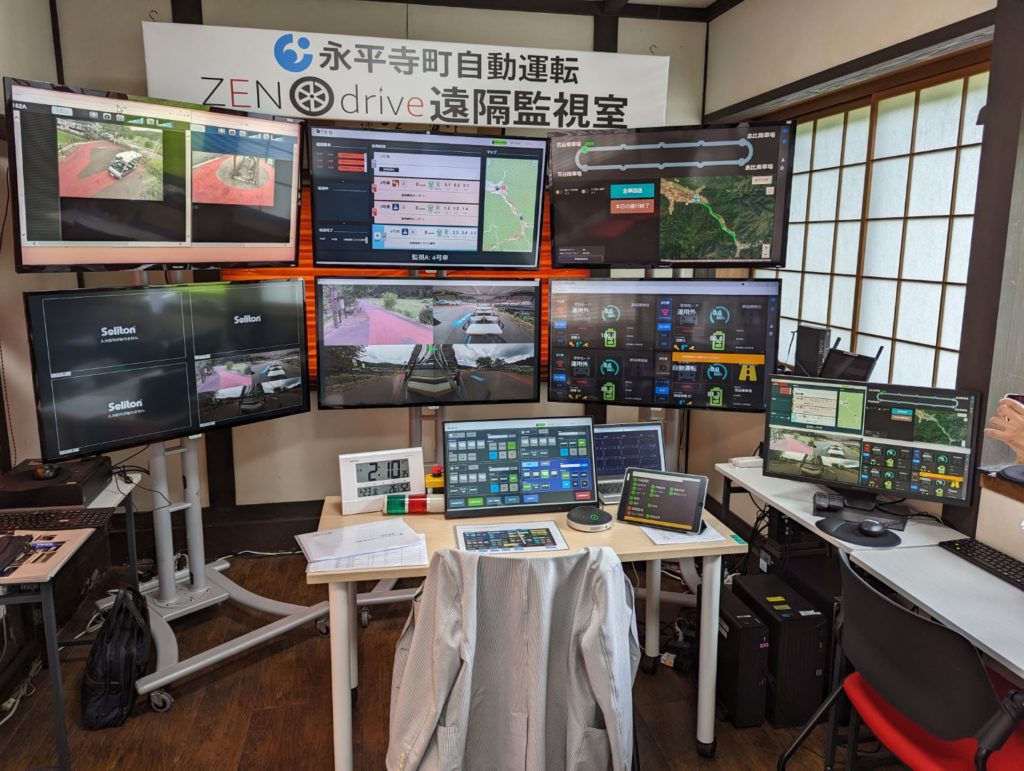
The remote monitoring room looks like a day trader’s desk, a place where you can check various information at a glance, such as vehicle operation status, vehicle condition, and camera footage from the vehicle. At first glance, it seems like there’s a lot to do, but apparently, operators generally don’t intervene unless something goes wrong (perhaps only when dispatching the vehicle). They say it’s simplified enough that operation management can be handled with about two days (was it?) of training (though looking at the photo, it doesn’t quite seem that way).
The Future of Private Paid Passenger Transportation
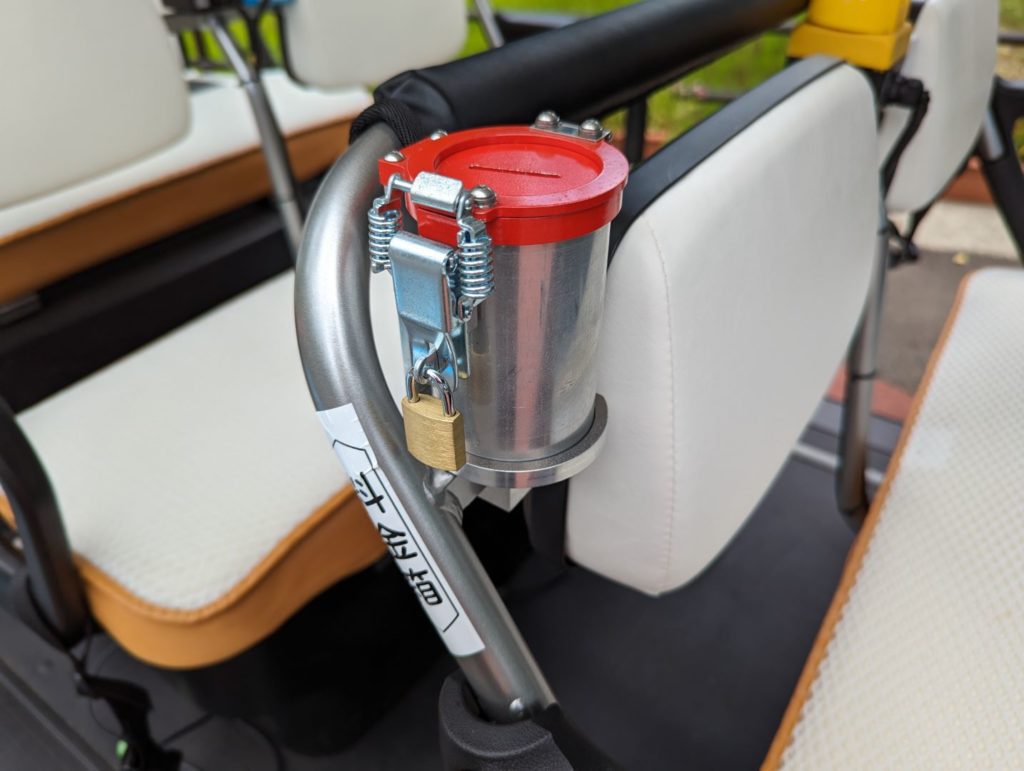
While protecting industries like railways, buses, and taxis, I believe that private paid passenger transportation will become increasingly important throughout Japan in the future, especially for ensuring transportation in areas where conventional services are no longer sufficient. Eiheiji’s MaaS is a prime example of this. As a simple and easy-to-understand fare collection system, there’s a fare box like this.
It was a Level 4 autonomous driving experience that offered many insights and much to ponder.


コメント