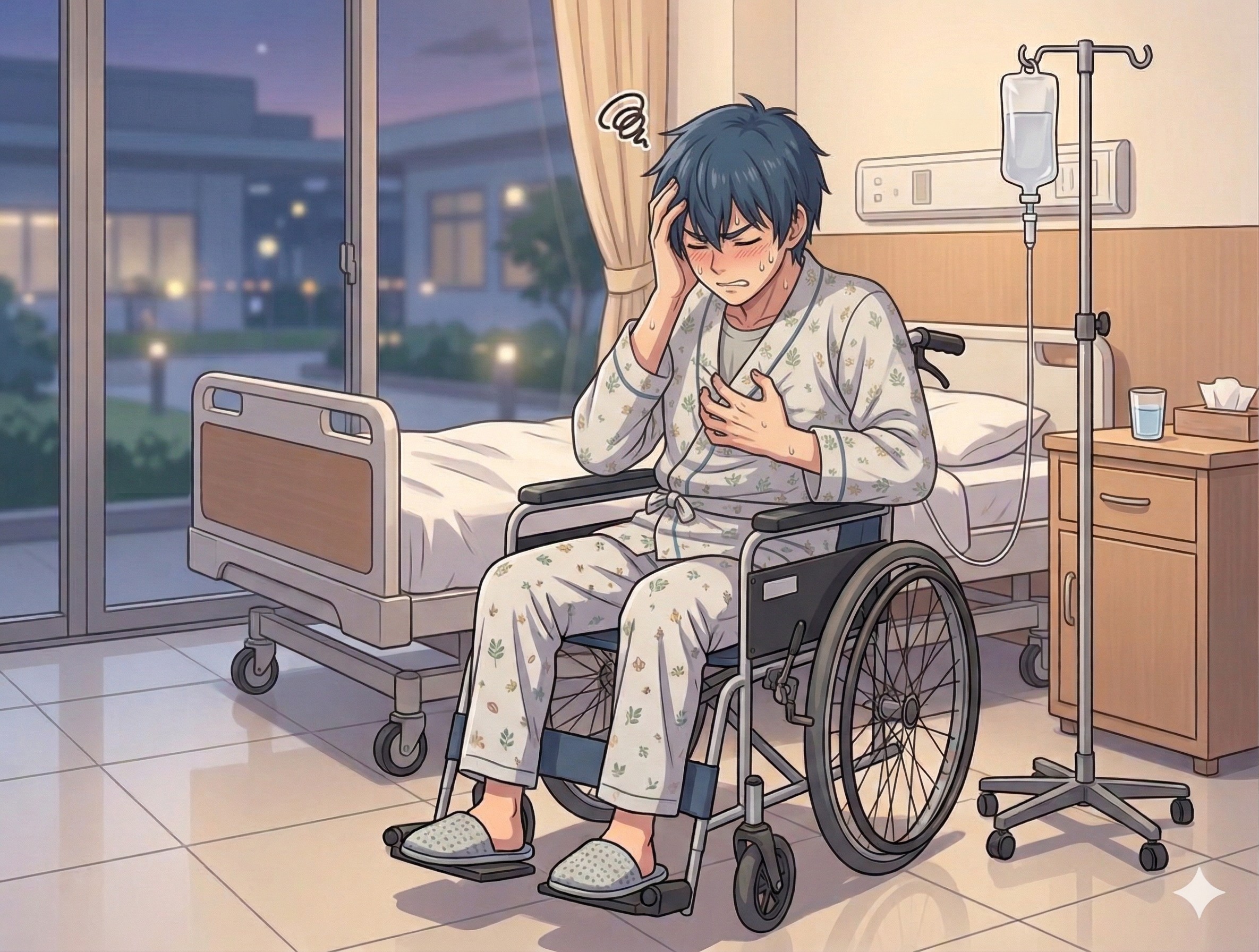
How it all started

About a month ago, after finishing my work-from-home shift, I was having just a tiny bit of beer after dinner (maybe half of a 350ml can) when I felt tipsy unusually fast. I stopped drinking and lay down on the carpet. A little later, I was suddenly hit with vertigo—the kind where the whole room spins. I could barely get up, so I crawled to the bathroom and vomited. I felt a bit better after that, but the dizzy, floating sensation remained, and I went to bed. The next day, I still felt a little off, like my body was floating. Since it was so sudden and I’d barely had anything to drink the night before, I was a bit concerned. However, the symptoms mostly disappeared after that. I figured the occasional dizzy spell would eventually go away, so I just left it alone. I was even able to handle a hike up Mt. Kitadake and Mt. Ainodake without any issues, so I stopped worrying about it much.

From a weird feeling at a memorial service to an ambulance ride…
However, about a week ago during a family memorial service, I felt a distinct, stronger dizziness that was different from the usual. I felt uneasy about the dinner following the service but decided to attend anyway, making sure to avoid alcohol and eat very little. The venue wasn’t a private room, and the sound of children crying at other tables started to get to me. I felt sick and went outside for some fresh air, but I didn’t recover. I ended up leaving early to head home. On the train, I felt terrible again and vomited in the station restroom. I could barely walk straight, and by the time I struggled back home, I couldn’t leave the bathroom. After vomiting dozens of times, my family came home and ended up calling an ambulance for me.
Hospitalized due to persistent vertigo and nausea
The paramedics were checking for things like eye tremors, headaches, numbness in my limbs, and my ability to speak—likely trying to determine if there was a serious brain-related issue. Even at the emergency hospital, they immediately ran a CT and MRI to check for any brain abnormalities. Once they confirmed my brain was fine, they told me to stay overnight since the vertigo and nausea were still strong. They advised me to see an ENT specialist later if I recovered, and I was discharged on Sunday morning.
ENT Consultation and Tests
Since I had collapsed once a month ago, I felt it was risky not knowing the cause. On Monday and Tuesday, I went back to the hospital’s ENT department. They performed hearing tests, checked my auditory nerve response, and examined the vertigo. It turned out I had a slight loss of high-frequency hearing in my right ear. We figured it was likely a lingering effect of the sudden sensorineural hearing loss I had nearly 20 years ago, but the doctor said that probably wasn’t the cause of the dizziness. The doctor suggested it might be due to intense stress, fatigue, or lack of sleep. To help ease my anxiety until they could explain the detailed test results in two weeks, they prescribed Adenos Kowa granules to suppress vertigo and Travelmin for nausea.
Following this, I decided to cancel my planned business trip to Europe to avoid stress, fatigue, and lack of sleep, and I began preparing to lighten my workload.
Sudden morning vertigo – Turning to a private ambulance
Yesterday morning, when I opened my eyes while facing left, the world started spinning again… I couldn’t even stand up. I crawled straight to the bathroom and vomited. This continued for over three hours. Since I knew my brain was fine, calling 911 (an emergency ambulance) didn’t seem right, but at the same time, I couldn’t even make it from my apartment door to a regular taxi…
In the midst of this, my wife did some research and found out about “private ambulances”—basically care taxis. After being turned down by several places, she finally found one that could send a vehicle. It was a van equipped for wheelchairs. They came right to our apartment door with a wheelchair, helped me into it, and transported me to the hospital. It’s really good to know that this option exists for those situations where it’s not quite a 911 emergency, but a regular taxi is impossible. That said, the driver mentioned they are usually fully booked and it’s hard to find an opening on short notice.
By the way, this private ambulance service provided all that help for an additional fee of about 3,500 yen on top of the standard taxi fare. I was so grateful.
Diagnosis and Re-hospitalization
Thanks to my wife calling the hospital in advance, the check-in went smoothly. Although the hospital had my history, I saw a different doctor this time, so I gave a brief summary before going in for hearing and eye movement tests. The hearing test showed that it wasn’t just the high-frequency range anymore; my hearing had dropped across the board, including low frequencies. They also confirmed the eye movements characteristic of vertigo. The diagnosis was likely either sudden sensorineural hearing loss or Meniere’s disease. To focus on recovering my hearing, I started steroid IV therapy immediately and was admitted for a one-week stay.
Maybe Meniere’s Disease?
Since the first doctor I saw told me that sudden sensorineural hearing loss usually doesn’t recur, I was curious and looked things up online. I found a page about “Delayed Endolymphatic Hydrops” that seemed to match my situation perfectly, which worried me a bit. According to the site, it involves severe hearing loss in one or both ears followed by recurring vertigo attacks years or decades later, while the hearing loss itself doesn’t fluctuate. In my case, I had sudden hearing loss nearly 20 years ago and am now experiencing repeated vertigo. The page mentioned the cause is unknown and there’s no cure, and it can be quite difficult if it becomes intractable and doesn’t respond to conservative treatment. I’m anxious, but there’s no use being trapped by fear. Since they recommend lifestyle improvements and stress reduction alongside medication, I want to try looking at things from that perspective again.

On the other hand, it seems a specific type of MRI is needed to diagnose Meniere’s. Even though the hospital I’m in is quite large, they don’t have that specific equipment, so we’re currently in a stage of planning further tests to figure it all out.

コメント