- It All Started with Unusual Vertigo
- A Shift in Balance and Vertigo Attacks
- Hardly Any Hearing Loss at First
- Potential Causes for the Vertigo
- Third Vertigo Attack and Re-hospitalization
- “Let’s Try Discharging You”
- Diagnosis via Contrast-Enhanced MRI
- The Verdict: Meniere’s Disease
- The Most Disgusting Medicine Ever: Isosorbide…
It All Started with Unusual Vertigo
As I’ve mentioned on this blog before, the whole thing started with a vertigo attack in a situation I’d never experienced. I’d had just a tiny bit to drink and felt strangely tipsy, so I lay down—only to be hit by intense spinning vertigo, followed by vomiting. Even the next morning, I still felt like I was floating. Eventually, the symptoms subsided, and since I was even able to go mountain climbing like usual, I stopped worrying about it.

A Shift in Balance and Vertigo Attacks
About two weeks later, my sense of balance clearly went haywire, and I collapsed from a violent bout of spinning vertigo. I was rushed to the hospital by ambulance, and while CT and MRI scans confirmed there was nothing wrong with my brain, I couldn’t move and had to be admitted. The vertigo lasted for several hours, but since it cleared up by the next morning, I was discharged as usual. However, having had two major attacks, I was advised to see an ENT specialist, so I went the day after I got home.
Hardly Any Hearing Loss at First
At the ENT clinic, they did hearing tests, checked my auditory nerve response, and looked for nystagmus (eye flickering) using Frenzel goggles. The hearing test showed that the high-frequency hearing in my right ear had dropped significantly. Since I had suffered from sudden sensorineural hearing loss in that same ear about 20 years ago, the doctor thought it was likely residual damage from then and probably wasn’t the direct cause of the vertigo. They also didn’t see any issues with my otolith function at that point.
Potential Causes for the Vertigo
I looked at the following article and compared it with my own symptoms.

Benign Paroxysmal Positional Vertigo (BPPV)
This is what my wife and I first suspected. It happens when calcium crystals (otoliths) in the inner ear get dislodged and float into the semicircular canals, causing spinning vertigo. However, the vertigo usually lasts for a very short time—about a minute. Also, while it recurs, it’s not supposed to be accompanied by hearing issues.
Comparing this to my symptoms, the duration of my vertigo didn’t match, but since I didn’t have any new hearing problems at the time, it seemed like the most plausible candidate.
Vestibular Neuritis
In vestibular neuritis, like BPPV, there are no hearing symptoms, but the vertigo attacks are characterized by lasting a long time—a day or more. Usually, it’s said to happen only once; if these attacks repeat, Meniere’s disease is often suspected.
My symptoms matched the “no hearing issues” (at the time) and the “long-lasting vertigo” parts, so I thought this was possible too. The mismatch was that I had already had at least two attacks, so it wasn’t a one-off event.
Sudden Sensorineural Hearing Loss
This can involve just hearing symptoms or hearing symptoms combined with vertigo. When vertigo is involved, it appears alongside the hearing loss. These attacks usually happen once and rarely repeat.
As I mentioned, I had this in my right ear 20 years ago (though without the intense vertigo). My doctor told me that sudden hearing loss doesn’t typically repeat, so while the symptoms looked similar, that probably wasn’t it.
Delayed Endolymphatic Hydrops
This is an intractable disease where profound hearing loss occurs first, followed years or even decades later by repeated bouts of spinning vertigo.
My doctor didn’t mention this one initially, focusing instead on the other three and Meniere’s.
However, given that I had sudden hearing loss 20 years ago and this new issue was in the same right ear, plus the recurring vertigo, it fit the description of delayed endolymphatic hydrops perfectly. Since there is currently no known cure for this—only symptom management—and it can significantly disrupt daily life, it was the diagnosis I feared most. Even after being diagnosed with Meniere’s, since that diagnosis is also based on the presence of endolymphatic hydrops, I still worry it might actually be this.
Meniere’s Disease
Meniere’s involves recurring vertigo that happens without a specific trigger, lasting anywhere from 10 minutes to several hours, accompanied by fluctuating hearing symptoms like hearing loss, tinnitus, or a feeling of fullness in the ear.
In the end, this was my diagnosis, but at that specific clinic visit, the doctor said they couldn’t confirm it yet because the hearing symptoms hadn’t shown up clearly alongside the vertigo.
Third Vertigo Attack and Re-hospitalization
Six days after the first ambulance ride, I woke up with a vertigo attack so bad I couldn’t move. I was hospitalized again. During the exam this time, my right ear showed an overall drop in hearing, including low frequencies. At this point, the diagnosis was narrowed down to either sudden hearing loss or Meniere’s disease.
During my week-long stay, the frequency of the attacks shot up, and they lasted anywhere from a few hours to a full day. I was forced to use a wheelchair for almost everything, including going to exams. Between IV needles slipping and leaking meds, and frequent intramuscular injections to suppress the vertigo and nausea, those were pretty miserable days.
“Let’s Try Discharging You”
I was originally supposed to be out in a week based on the steroid IV schedule, but because I kept having attacks that left me incapacitated, the doctor was unsure about the discharge date. Ultimately, though, the doctor explained that since it was a 24-hour emergency ward and I would eventually have to get “used” to the vertigo, it would be better to stick to the plan and go home.
When I left, both the vertigo and hearing symptoms were still there, and the exact diagnosis hadn’t been nailed down. Here was the plan at discharge:
- Get a contrast-enhanced MRI of the inner ear at an outside clinic to confirm Meniere’s. We tried to check for Meniere’s in the hospital using a diuretic IV followed by a hearing test, but the results weren’t clear enough, and a false positive was suspected.
- Since the diagnosis wasn’t 100% and symptoms remained, I was prescribed meds for the vertigo, nausea, and hearing recovery. Specifically:
- ATP (Adenosine Triphosphate Disodium): Dilates blood vessels to improve blood flow.
- Methycobal: Vitamin B12 to help peripheral nerve function.
- Betahistine Mesylate: Improves inner ear blood flow to suppress vertigo.
- Travelmin: Suppresses inner ear and brain excitement to control dizziness and nausea.
At first, I was like, “Wait, I’m going home in this state?” but it worked out. After leaving, the vertigo definitely continued (honestly, you never get used to it…), but I didn’t have any more attacks so severe that I collapsed and couldn’t move.
Diagnosis via Contrast-Enhanced MRI
The MRI required two scans with a 4-hour gap and used a contrast agent. Since I have cough variant asthma, the doctor was very thorough in asking about my symptoms to check for allergy risks. I had the contrast injection during the first scan and had to stay at the clinic for an hour after to make sure I was okay. It was a bit nerve-wracking. I had a slight headache, but no major issues, and I finished the second scan. The results were sent from the clinic back to the hospital.
The Verdict: Meniere’s Disease
A few days later, the hospital confirmed the diagnosis was Meniere’s disease. Looking at the MRI images, the black area in my right inner ear was clearly larger than the left, which indicated endolymphatic hydrops (swelling from excess fluid). With the diagnosis confirmed, the treatment plan became clear, starting with a month of observation:
- Meniere’s is often triggered by stress, fatigue, or lack of sleep, so I need to review my lifestyle and take some time to rest.
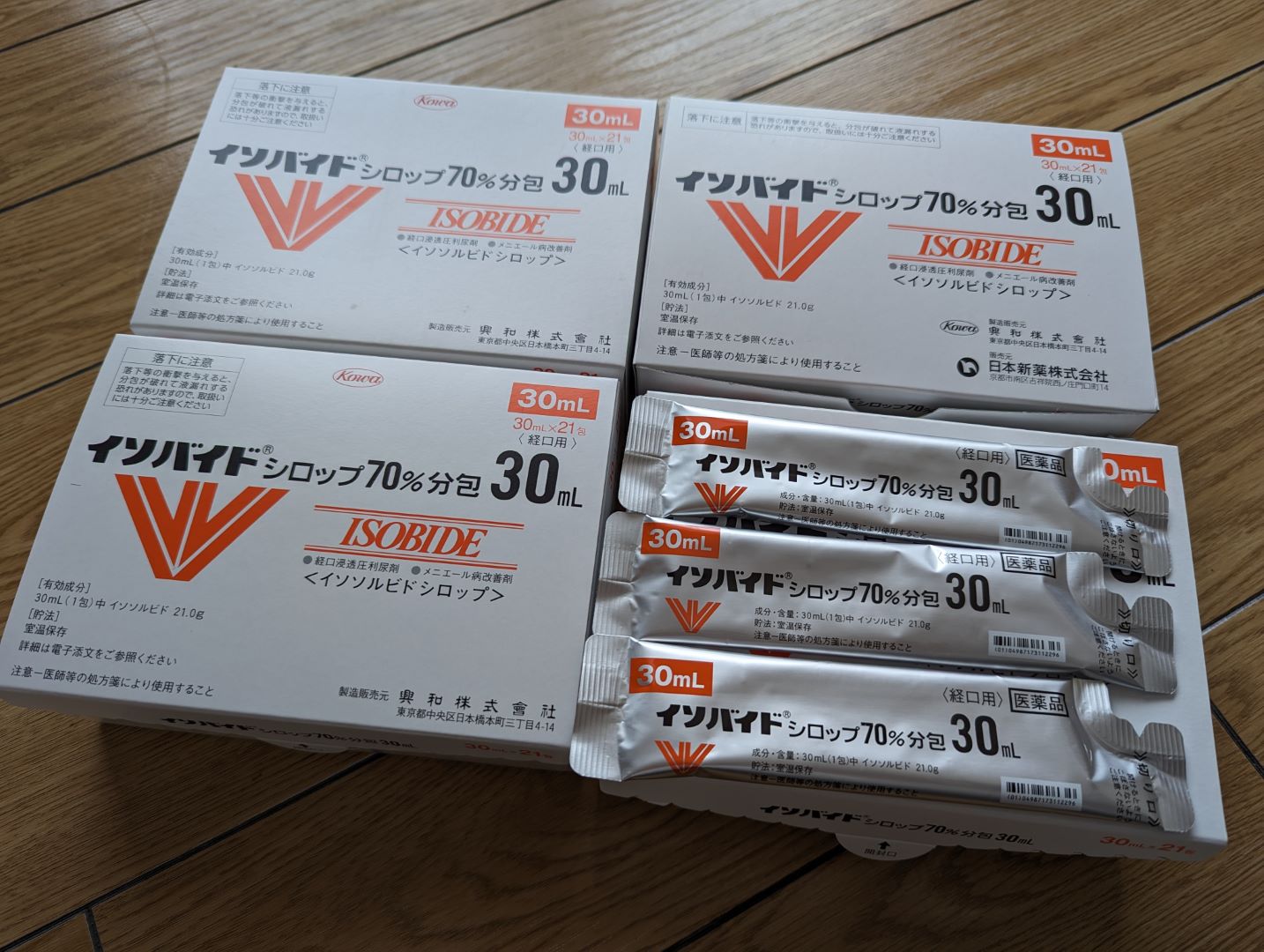
- Take a diuretic called Isosorbide and drink plenty of caffeine-free fluids.
I’m currently in the middle of this treatment. Since being discharged, the vertigo attacks have stopped, and that constant feeling of being off-balance has mostly disappeared. However, my hearing still hasn’t returned to normal.
The Most Disgusting Medicine Ever: Isosorbide…
Back when I had sudden hearing loss 20 years ago, they suspected Meniere’s then too and put me on Isosorbide. This stuff is a truly foul syrup. Taking it after every meal is a struggle. Imagine those sweet medicines for kids, but concentrated by 100 and then infused with intense bitterness. It tastes awful and leaves your throat feeling like it’s burning. I looked up ways to make it better—some people mix it with citrus juice or use a jelly version—but honestly, diluting it just seems to increase the volume of the grossness you have to drink. My strategy? I keep it in the freezer (it doesn’t actually freeze) and just knock it back in one go. A month’s supply weighs several kilograms, and looking at that pile of meds is enough to make anyone lose heart (lol).

コメント