The evolution of software development with generative AI recently has been so incredible that the term “Vibe Coding” might already feel like a relic of the past. I really wanted to experience it firsthand. So, I tried out “chat-complete development” – building a Shikoku Pilgrimage reflection app that displays tons of photos and blog posts on a map, something I’ve always wanted, using nothing but chats with Gemini.
New Ideas Born from Interactive Exchanges with AI
This was the most surprising aspect of chat-complete development, and in a way, its greatest charm. When I gave various instructions, Gemini would sometimes propose, “I’ve implemented it, but how about this feature?” These suggestions often included unexpected and interesting ideas that I hadn’t thought of myself, which makes it more fascinating than just a code generation tool.
Another strength is that it’s chat-based, so you can develop anywhere. If an idea suddenly pops into your head during your commute, you can immediately throw it to Gemini for consideration or solidify your code concepts. This ability to work on things whenever an idea strikes, without being tied to a specific time, is a huge advantage for enjoying development without stress, I think.
This Shikoku Pilgrimage reflection app was developed in just a few days, but it became a project of a considerable scale. As the interactions grew longer, the previously shared context sometimes faded, leading to regressions where requesting a full program generation would unexpectedly alter previous behavior. Because of this, I settled on a style where I only asked for “code diffs” and manually confirmed the integration. For a while, I considered incorporating Antigravity to always keep the entire codebase in mind and prevent context loss or unexpected regressions. However, I soon realized that developing through natural language interactions, free from the constraints of code, was quite enjoyable in itself, and it changed the way I found pleasure in development.
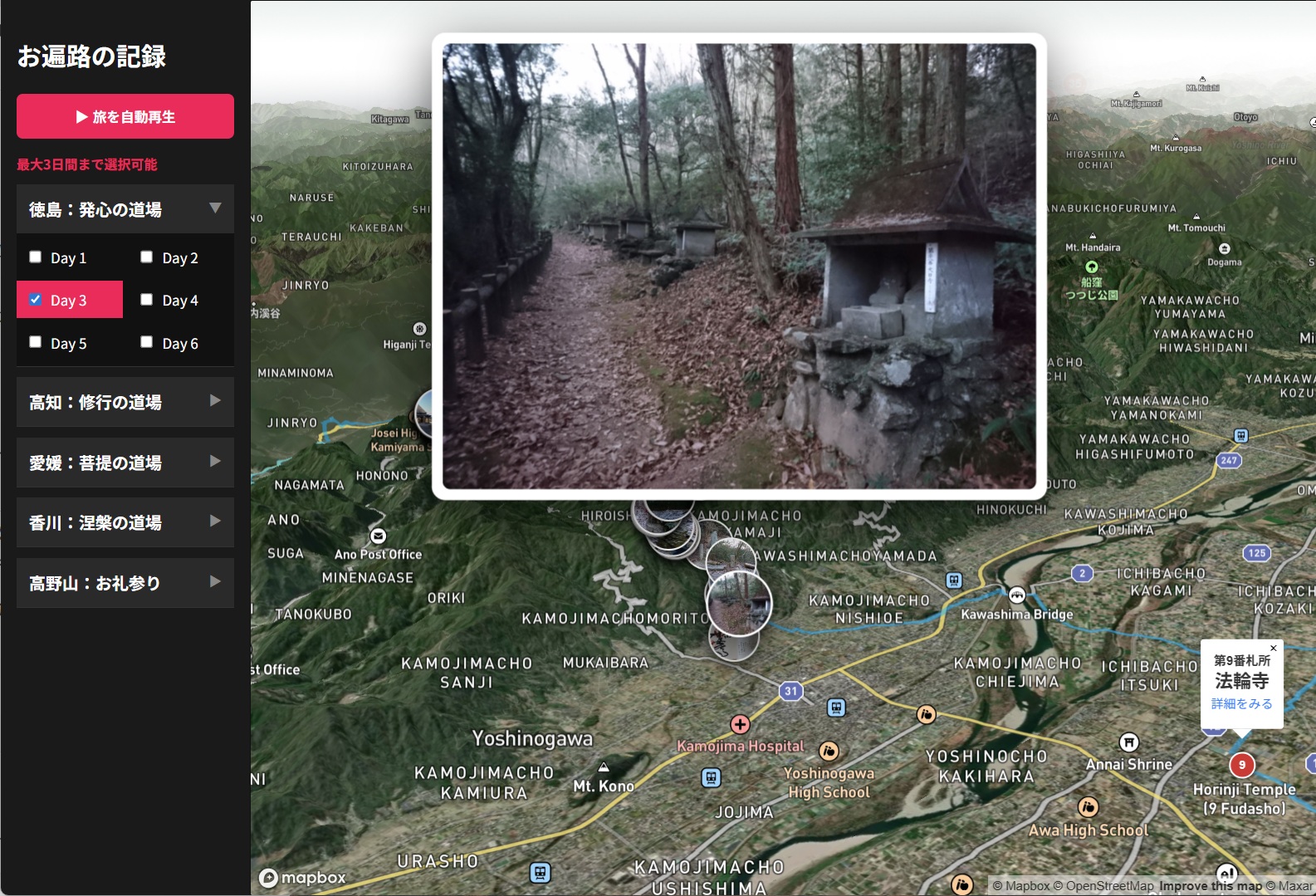
What I found particularly interesting during these interactive exchanges was when I struggled to convey the camera work in natural language for the feature that automatically plays back photos along the route. After much trial and error, when I finally achieved a satisfactory movement, Gemini uttered, “That’s truly a ‘God’s-eye view’!” It was funny because the AI understood the intent behind the hard-to-describe camera movement, and I couldn’t help but laugh.
Even if you abandon “implementation,” it’s hard to abandon an “engineer’s perspective.”
There’s a saying that “anyone can create apps if they leave it to AI,” and in “chat-complete development,” I did feel that there’s certainly some truth to that. However, when I actually tried it myself, I realized that having an engineer’s perspective or background is still important. Although it can create “working prototypes” surprisingly quickly just through chat, I feel that non-engineers might not easily come up with ideas like the following:
- Lightening large numbers of photos or extensive GPX files through pre-processing
- Optimizing memory usage and improving performance when handling large volumes of photos
- Separating resources from logic for internationalization, etc.
It seems that, at least for now, it’s necessary to incorporate these perspectives as instructions for the AI to anticipate potential bottlenecks in the output.
Bug Fixing via Image Sharing
If the program throws an error, you can just give it to the AI, and it fixes it immediately. What truly surprised me was that even when there was no error, but the behavior wasn’t what I expected, I could attach a screenshot and say, “Something’s off here on this screen,” and it understood and fixed it properly. Being able to overcome hard-to-verbalize UI discrepancies through such interactions (even though it’s via chat) felt like a unique multimodal AI experience.
Finally
Aside from the joy of writing code, I felt there’s a different kind of joy in this “chat-complete development”: “the joy of conveying intent through language and bringing it to life.” The process of leveraging one’s engineering knowledge and shaping things through dialogue with AI felt, in a way, like a new creative work. Humans conceive what they want to create, verbalize it to the AI, evaluate the resulting form, and refine it into a better shape. This might even require a bit of design sense, but since it can be done in a very short cycle, there’s a pleasure in overcoming that hurdle. I even thought some people might get really hooked on this!
The app I created in about three days is available here, supporting both Japanese and English, and enjoyable on both PC and mobile. I was genuinely amazed at how much I could accomplish in such a short period.



コメント