
- The Bank Account I Opened While Living in Sweden
- Can’t Access My Account… The Digipass Battery Died
- They Couldn’t Send Me a New Digipass…
- Help from a Swedish Friend
- Preparing 4 Documents
- Preparing a Verified Passport Copy
- Preparing the Payment Instruction Form
- Preparing a Copy of the Account Statement from the Recipient’s Bank Confirming Bank Details
- Account Closed and Balance Transferred to the Designated Account Without a Hitch!
- Bonus Round…
The Bank Account I Opened While Living in Sweden
While I was living in Sweden, I opened bank accounts there to manage my daily finances, including receiving my salary. For convenience, I actually opened two accounts. One of them was linked to a Mastercard credit card with debit functionality, and I could access both accounts online to easily adjust balances between them as needed.
I could have closed the accounts when I moved back to Japan, but the exchange rate at the time was quite strong for the yen, which wasn’t ideal. Plus, I just missed the timing amidst all the chaos of moving back. Even so, since I still had the credit card and could access the accounts online, it wasn’t a problem; in fact, it was quite convenient for overseas business trips, so I just kept using them normally even after returning.
Can’t Access My Account… The Digipass Battery Died
The trigger was the Digipass running out of battery, which is essential for two-factor authentication to access my account online. I could no longer check my account balance easily (though they did send me paper statements of deposits and withdrawals to Japan periodically, so I could still get by), and I couldn’t transfer funds from one account to the one linked to my credit card, so I knew I had to do something about it.
They Couldn’t Send Me a New Digipass…
I called the bank and explained the situation, asking if they could send me a new Digipass. They told me that identity verification was a prerequisite, and since my Swedish personal identification number had expired, the only way to verify my identity was for me to physically go to a bank branch in Sweden and prove who I was with my passport. This left me with a choice: either do that or consider closing the account.
So, I started leaning towards closing the account.
Help from a Swedish Friend

When I first contacted the Swedish bank about closing my account, they wouldn’t let me discuss it via email, insisting on phone calls, which was a real pain. It was tough to find a time that worked, and the procedure was quite complicated, so I just left it untouched for a while.
However, recently, a Swedish friend who was visiting Japan and I hiked Mount Fuji together. We happened to talk about this issue, and she was kind enough to first call the bank to confirm the necessary procedures. She even got me a contact person I could communicate with via email to handle the series of steps required to close the account. What a lifesaver!
Preparing 4 Documents
As a result of my communications with the bank, I found out I needed to prepare the following four documents:
- Verified passport copy, we accept verified passport copy only from Embassy, Consulate or Notary Public. (Verified passport copy: Only copies verified by an Embassy, Consulate, or Notary Public are accepted.)
- Assignment letter with request for transfer of balance and closing of account. If you have no information about balance, just state “total balance”. (Instruction letter requesting balance transfer and account closure: If you don’t know the balance, just state “total balance”.)
- Payment instruction form filled out and signed, see attachment. (Filled and signed payment instruction form: Fill out and sign the attached payment instruction form.)
- Copy of account statement from the recipient’s bank confirming the bank details, signed and stamped by the recipient’s bank. (Copy of account statement from the recipient’s bank confirming bank details: Ensure it is signed and stamped by the recipient’s bank.)
The second item was easy enough, as I just needed to write the English text myself. However, I struggled quite a bit with the remaining three. Still, it was interesting to learn a lot of new things along the way!
Preparing a Verified Passport Copy
Regarding the verified passport copy, I knew simply sending a photocopy wouldn’t suffice. So, I first contacted the Swedish Embassy, explained the situation, and told them the Swedish bank was requesting a passport copy verified by an embassy. Their reply was, “As a general rule, we do not handle certifications for Japanese nationals. For Japanese nationals, this process is handled by the nearest Japanese Notary Public office.”
So, I looked into what a notary public’s verification of a passport copy actually entailed. I learned that a notary public cannot authenticate the original passport itself or its contents. Furthermore, a notary public can only authenticate private documents (私署証書), and since a passport copy is an image and not a private document, they cannot authenticate the copy itself. This was quite a revelation.
Because of this, even though the original instructions did mention verification by a notary public office or an embassy/consulate, I became unsure if just a notary public’s verification would truly be sufficient.
Digging a bit deeper, I discovered something called “Apostille.” This is a certification issued by the Ministry of Foreign Affairs for public documents issued by Japanese government agencies or local authorities. I learned that if a country is a signatory to the Hague Convention, obtaining an Apostille allows the document to be used in the destination country as equivalent to a consular legalization from an embassy or (consulate general) in Japan.
Based on these two pieces of information, I came to believe that doing the following would likely solve the problem:
Preparing a declaration stating the passport copy is genuine, and having it notarized by a public notary.
I would create a declaration stating that the passport copy is a correct copy of my own valid passport issued by the Japanese government, that I have personally compared its contents with the original and confirmed they are identical, and that the purpose of using this copy is to close my Swedish bank account. Then, I would bring this declaration, the passport copy, and my original passport to a notary public, sign the declaration in front of the notary, and have them authenticate it as a private document.
Obtaining an Apostille from the Ministry of Foreign Affairs for the above (as a substitute for the embassy/consulate certification requested by the bank).
If I could get an Apostille for the document authenticated by the notary public (the declaration mentioned above), it should be treated as equivalent to consular legalization by an embassy or consulate in the case of Sweden, which is a signatory to the Hague Convention.
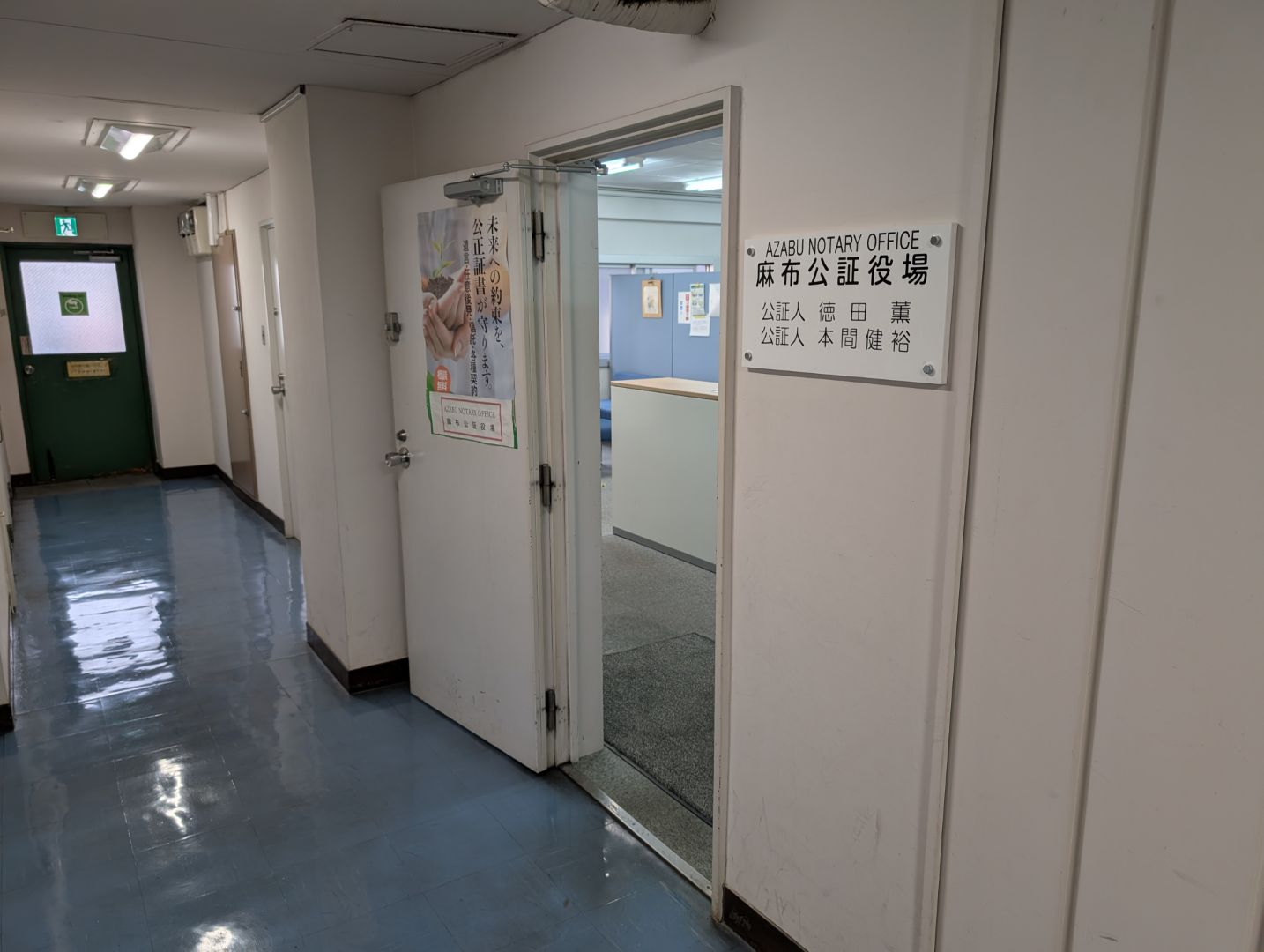
I was quite anxious about whether this was actually the correct procedure, but when I called the Azabu Notary Public Office to confirm in advance, I learned that some notary public offices in Tokyo offer a one-stop service to create an authenticated document with both notary public certification and an Apostille from the Ministry of Foreign Affairs. This also helped confirm that my approach seemed correct.
By the way, I used a generative AI to create a template for the declaration based on the context above, and then I prepared the English version myself. The cost for the notary public’s authentication of this English private document was 11,500 yen. Generative AI was a huge help in all the research and document preparation up to this point – truly convenient!
Preparing the Payment Instruction Form
The payment instruction form sent by the bank was quite challenging to decipher, partly because this was my first time dealing with this kind of process. The images below show a portion of it. There are several types of balance payments, and naturally, the required fees vary significantly. I also had to consider which account would be suitable for each payment method.
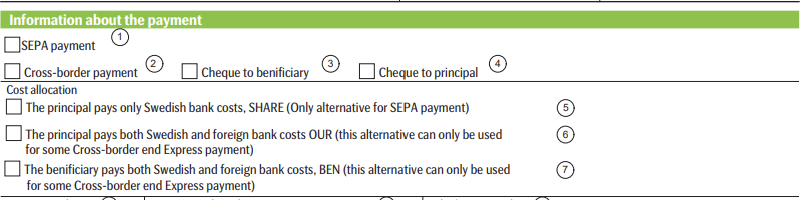
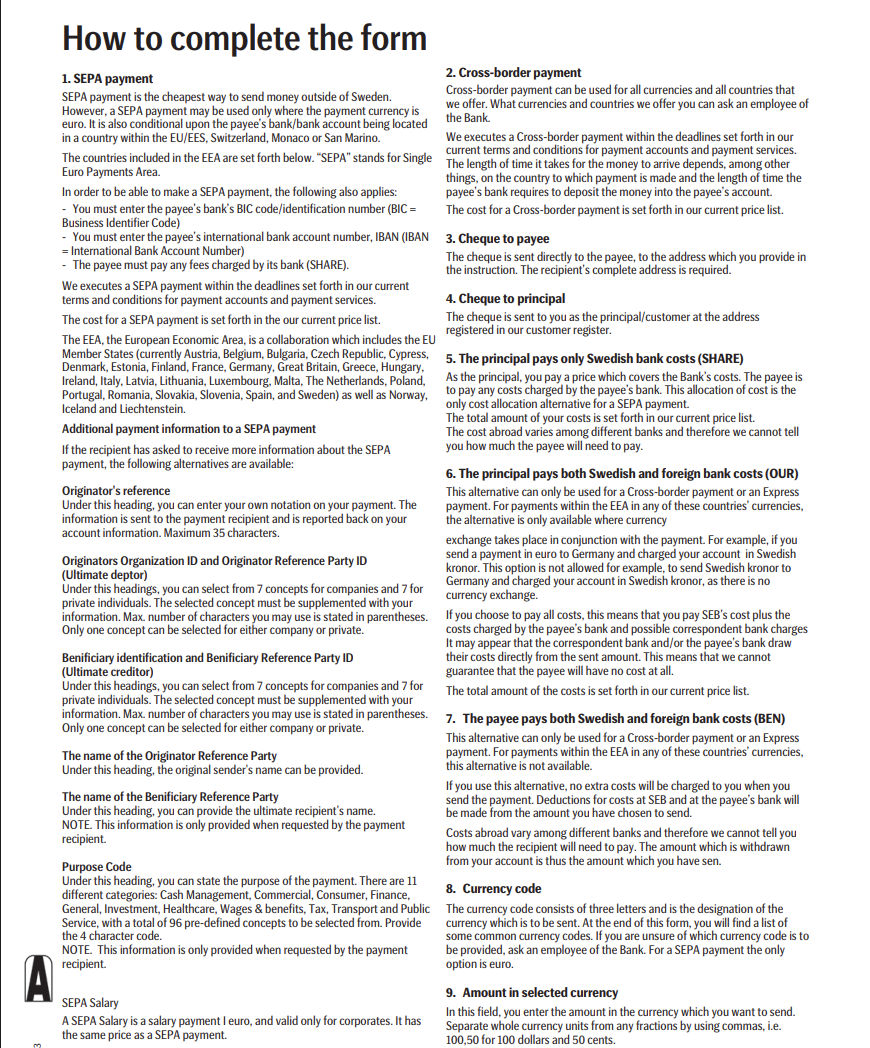
I wanted to choose the SEPA payment, which was stated to have the lowest fees. However, to do so, all transactions would need to be in Euros, meaning I would need a Euro-denominated bank account.
Actually, I had simply assumed that sending funds in Swedish Kronor would be the cheapest option. So, I had already looked into creating an account that could handle SEK transactions and even set up a Swedish Kronor account with WISE, which seemed like the easiest choice. But that turned out to be a waste of time…
Nevertheless, since WISE also allows for easy creation of Euro accounts, having an account with WISE made preparing for the Euro transfer relatively simple. I’ve put an invitation link to create a WISE account below; I’d be happy if you find it useful!

Preparing a Copy of the Account Statement from the Recipient’s Bank Confirming Bank Details
With WISE, it seems like requests for this kind of document are common. When I explained my situation to customer support via the app and asked if they could help, they promptly sent me a copy of the account statement signed and stamped by the bank. Plus, I could actually download the relevant PDF directly from the app, which was incredibly convenient.
Account Closed and Balance Transferred to the Designated Account Without a Hitch!
After mailing the originals of the four specified documents to the designated address in Sweden, the funds were transferred to my WISE Euro account in just under two weeks. The preparation was quite a hassle, but the actual process thereafter went smoothly without any problems, which was a huge relief.
Bonus Round…
While I did manage to get everything done, there were a few minor issues.
If identity verification was possible, a Digipass re-issue might have been an option.
Honestly, I didn’t actually want to close my Swedish bank account. It would have been more convenient if I could have gotten a new Digipass, kept the account, and held some funds in non-Japanese Yen, which I could then freely use with a debit card or similar. The reason they couldn’t issue a Digipass was due to identity verification issues. Since this current process essentially verified my identity, I wonder if I could have used that as a basis to get a Digipass re-issued. It’s something to think about.
WISE’s fund holding limit.
This was unexpected: WISE has a limit where you can only hold up to the equivalent of 1 million Japanese Yen in your account. Since I transferred more than that this time, I was forced to move the excess funds to another bank account. As a result, some of the money I had wanted to keep in non-Japanese Yen had to be forcibly converted to Yen, which wasn’t part of the plan (though, given the weak Yen, I’m trying to tell myself the timing wasn’t so bad after all).
Potential dealings with the tax office and tax filing implications?
In Sweden’s case, banks have an obligation to report overseas transfers above a certain amount to the Swedish tax authorities. So, I’m thinking there might be a chance I’ll hear from the Swedish tax office. Also, since I ended up having to move some of the Yen back to a Japanese account, I’m wondering if I’ll need to deal with tax filing (確定申告) for that? There are still some unclear parts.
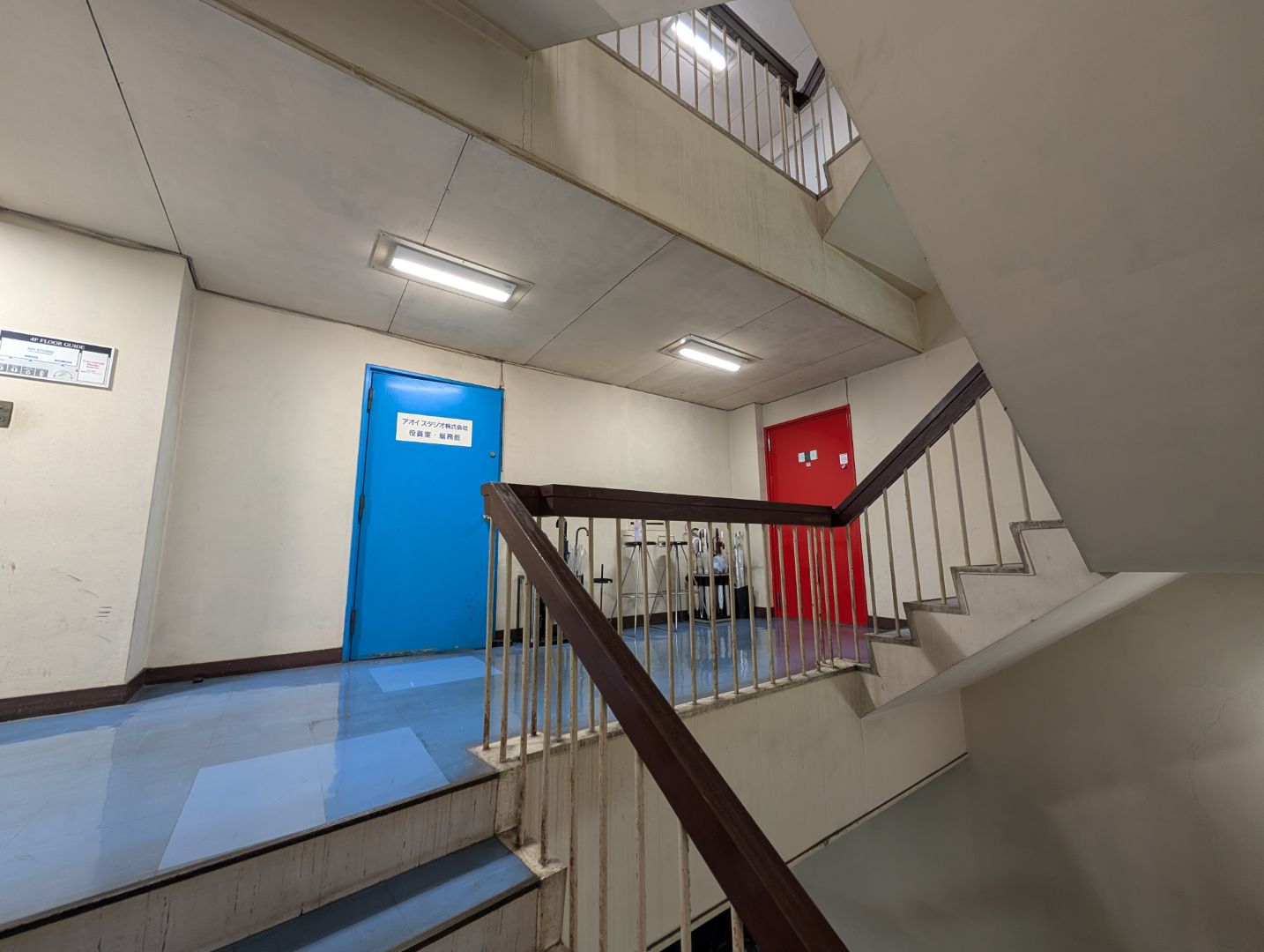
Finally, it was my first time visiting a notary public office, and the building had such a unique atmosphere. Signing a document right in front of the notary and having them authenticate it was an experience I’d never had before, and it was quite interesting overall!


コメント