
The “Overwhelming Scale” Caught My Eye
That poster with Tofukuji right in the center in big yellow font on a lime green background, surrounded by a lively bunch of Five Hundred Arhats – it really grabbed my attention. It talked about a “large-scale exhibition of Tofukuji, a major Zen temple in Kyoto, with overwhelming scale, where everything is beyond standard.” Since the exhibition was ending during Golden Week, I wanted to go before it got too crowded. Maybe it’s also because the Tokyo National Museum’s “All about National Treasures of the Tokyo National Museum” last year was incredibly amazing, which is still fresh in my mind.
My Personal Highlights: The Giant Temple Complex and Buddhist Sculptures
One of the highlights of this exhibition, where Tofukuji’s treasures are showcased all together, was the complete public display of “Five Hundred Arhats” by the Buddhist painter Mincho, which is usually shown in several parts over the exhibition period. This is a massive work spanning 50 scrolls, with 10 arhats depicted on each, vividly brought back to life through restoration. The Five Hundred Arhats at Rakan-ji Temple in Meguro, affectionately known as “Rakan-san,” with their approximately 300 unique facial expressions, always impressed me, but seeing them depicted in paintings is quite something too.
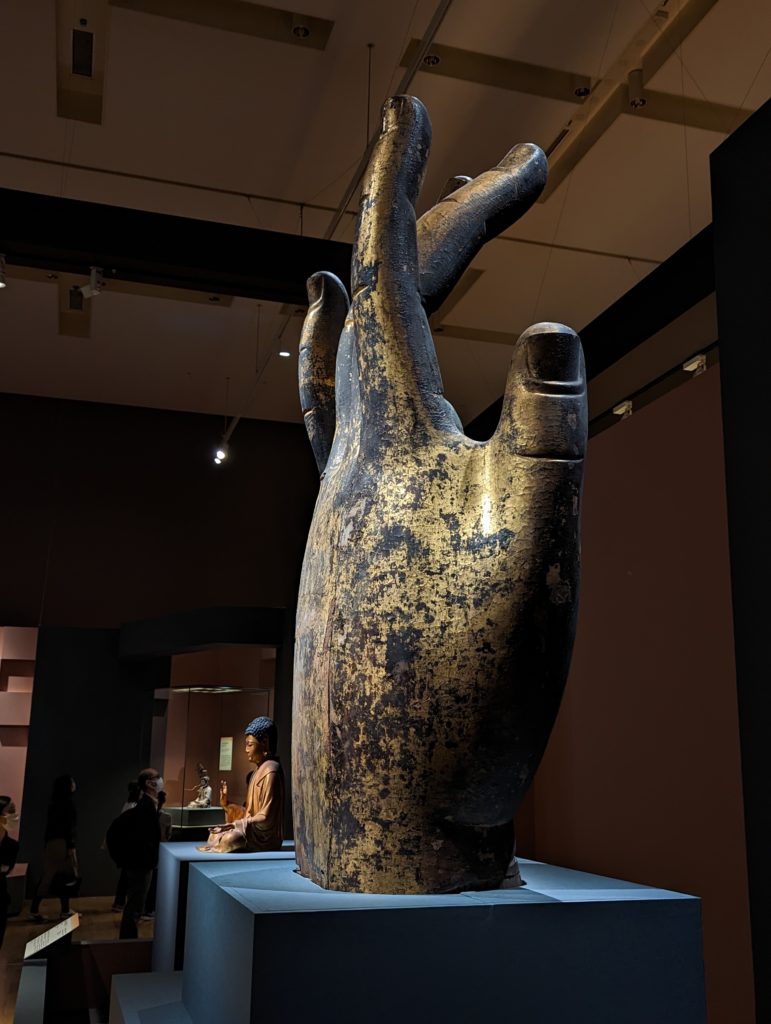
My personal highlight was the last room on the viewing route: “Giant Temple Complex and Buddhist Sculptures.” As soon as you enter, huge Nitenno (Two Heavenly Kings) statues and powerful Shitenno (Four Heavenly Kings) statues immediately catch your eye, and they are truly breathtaking. There was a section in the same room where photography was allowed, so I took some pictures, but the sheer impact of the statues on the left side of this photo was incredible. Also exhibited here were the statues of Kashyapa and Ananda, who serve as attendant figures to the main deity in Tofukuji’s Buddha Hall. These were also quite large and had a unique appearance that captivated me. The Nitenno statues that first caught my eye in this room are displayed on either side of the Kashyapa and Ananda statues, meaning there were a total of four gigantic statues standing there. Looking up at them from close range, their overwhelming power made me gasp involuntarily. Seeing them up close allowed me to marvel at their expressions, their powerfully sculpted muscles, and their dynamic poses that seem ready to spring into action at any moment.
Another thing that captivated me at this exhibition was the death poem (yuige) said to have been left by the Zen monk Enni on his deathbed. It contained a few characters, “利生方便 七十九年 欲知端的 佛祖不傳” (roughly, “For the benefit of sentient beings, seventy-nine years. If you wish to know the ultimate truth, it is not transmitted by Buddhas and patriarchs”) along with a date. The calligraphy was so powerful that it conveyed the full effort he put into writing it at the very end of his life.
Exploring Sesshu’s Landscape Paintings
On this day, I decided to check out a VR experience at the museum theater that stereoscopically brought to life the world of Sesshu’s landscape paintings, allowing you to journey deeper and deeper into them. While I knew his name well, I actually wasn’t very familiar with Sesshu’s landscape paintings. The first thing that struck me as interesting was that these landscape paintings aren’t depictions of actual scenery, but rather imaginary landscapes.
This presentation depicted the three-dimensional composition of the landscape paintings, creating content that made viewers feel like they were entering deeper and deeper into that world. It was like stepping right into the scenery of the landscape paintings, and I felt like I learned a new way to appreciate and enjoy them.
コメント